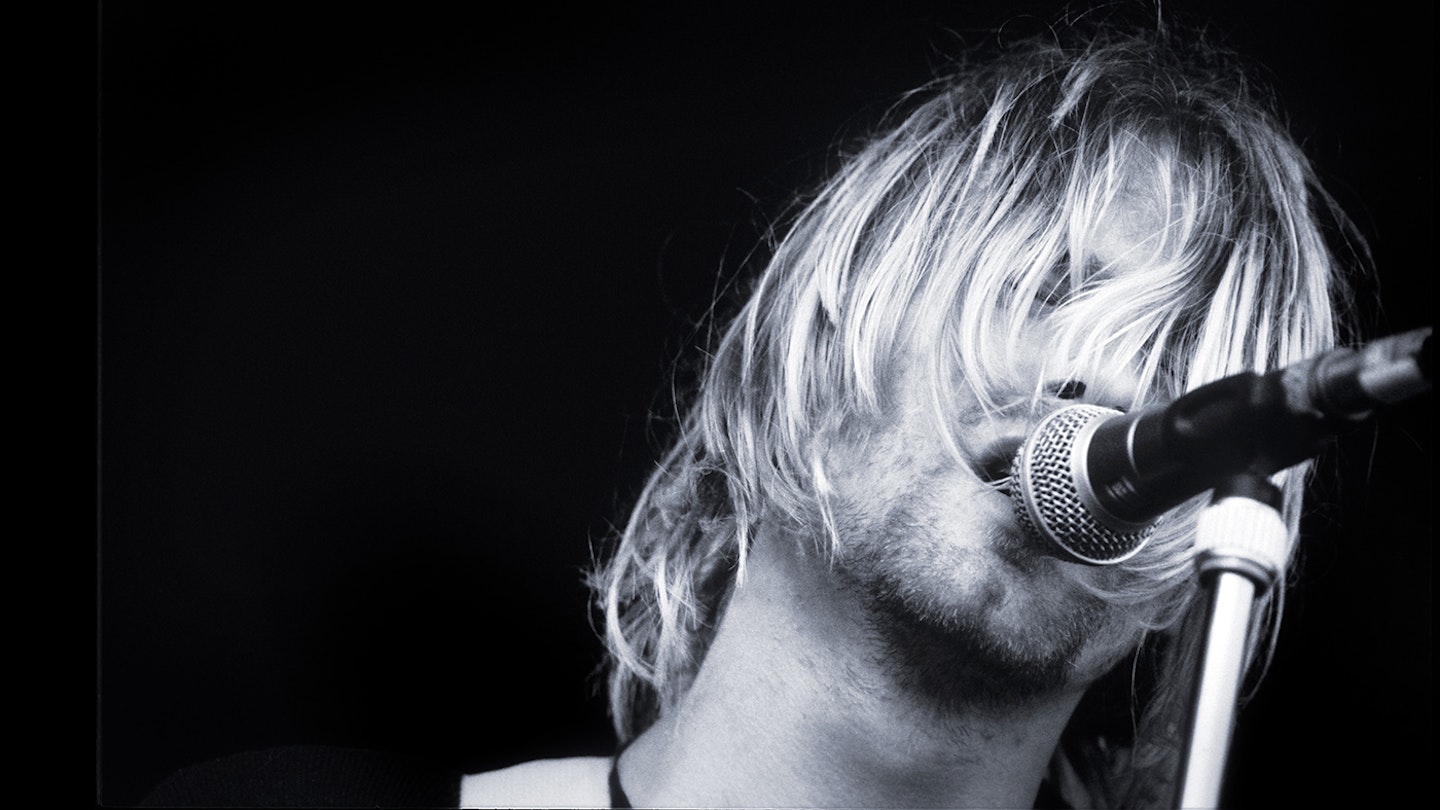
Nirvana began 1991 as just another grunge outfit from Seattle but, thanks to Nevermind and Smells Like Teen Spirit, ended the year as the biggest band on the planet. Having been an early champion of the band at UK music weekly Sounds, MOJO’s Keith Cameron was welcomed into the band’s inner circle, and given a seat on their tour bus, during the 12 months that changed the world of Kurt Cobain’s group – and music – forever...
IN THE MORNING OF August 21, 1991, Krist Novoselic walks into the lobby of a hotel in Ireland and waves his credit card in the air. Not that the piece of rectangular plastic is actually his; according to the embossed lettering, it belongs to an organisation called ‘NIRVANA INC’.
Novoselic does not conventionally resemble a corporate player. At six foot seven, with ripped jeans, unkempt beard and flyaway hair, his elongated frame wobbling around as he speaks, he looks more like a scarecrow directing the traffic. Bemoaning a hangover, he sits down and turns his attention to the tumultuous events in the Soviet Union, where President Gorbachev has been placed under house arrest amid an attempted coup by a group of Kremlin hardliners alarmed that Gorbachev’s reforms will bring about the collapse of the USSR.
“I’ve just been on the phone to Boris Yeltsin,” Krist declares. “He asked me to come over and help him sort things out, and I said, Sure, but he’d have to wait till after Reading. Sorry!”
Just as he isn’t the typical holder of a company credit card, nor does Novoselic fit the mould of a world current affairs expert. He is, after all, the bass player in an American rock band. But of course, as the world would soon discover, his is no ordinary rock band: in six months’ time, NIRVANA INC will usurp Michael Jackson at the top of the US album chart.
THE PREVIOUS EVENING, NIRVANA had played Sir Henry’s, a small club on South Main Street in Cork, as the support act to Sonic Youth. There couldn’t have been more than 200 people in the audience, and none of them was sufficiently bothered about Nirvana to rush down to the front. I was there with photographer Ed Sirrs to put together a feature article for NME. Later that day, we’d drive with the band to the Dublin seaside suburb of Dún Laoghaire for a gig at the Top Hat club. Then Nirvana would cross the Irish Sea for their first ever UK festival appearance, taking up a mid-Friday afternoon slot at Reading. As Krist started muttering about the KGB, I asked him about that credit card and he laughed again; he couldn’t take it seriously.
The facts stated he was in a band which had signed a record deal with a major label founded by legendary music mogul David Geffen, and yet his material circumstances were just as they had been 12 months earlier. He still lived with his wife Shelli in a one-bedroom house in Tacoma, a blue-collar satellite town equidistant between Olympia, the Washington state capital, and Seattle, the state’s largest city. Krist and Shelli had little space but were always generous hosts. In September 1990, I travelled there with photographer Ian Tilton to write a cover story on Nirvana for the UK music weekly Sounds. We saw Nirvana headline their biggest show yet in Seattle, at the 1,500-capacity Motorsports International Garage, and were privileged to witness the band’s one and only performance with Mudhoney’s Dan Peters on drums. In lieu of a hotel to stay in, the Novoselics threw a mattress onto the living room floor. We awoke the next morning to the smell of a cooked breakfast and Krist serenading us with Black Flag songs.
During the summer of 1991, his bandmates’ domestic arrangements were equally modest. Dave Grohl, the latest in a long succession of Nirvana drummers, had just begun sharing an apartment in West Seattle, having grown tired of living on a couch in a squalid apartment on Pear Street, just outside the centre of Olympia. Grohl’s roommate in Pear Street was Kurt Cobain, who had lived there since moving in with his girlfriend Tracy Marander in 1987. It was after the couple had broken up in 1990 that Grohl quit squatting with the Novoselics and took up residence with Cobain.
“The kitchen was absolutely destroyed, it was so disgusting,” remembered Grohl when we met in 2006. “There was mould everywhere. There was never anything in the refrigerator – I’m not even sure it worked. You walked from this tiny kitchen into a 12-by-12 living room that had a TV that didn’t work, a record player – there was maybe 12 records – a lamp and a couch, and then half the room was taken up by this massive turtle aquarium Kurt had built that had two dying, smelly turtles in it. You walked through there into a tiny bedroom that Kurt had painted black (laughs), and then a bathroom the size of a fucking airplane bathroom. That’s where we lived.”
As the Nirvana tour bus made its way from Cork to Dublin, the video machine played This Is Spinal Tap. Chuckling at the scene where the one-time ‘world’s loudest band’ gather disconsolately at Elvis Presley’s grave, Novoselic suggested that “too much fucking perspective” was no bad thing. The son of Croatian migrants, he felt keenly aware of the tumult that would soon be unleashed in his family’s homeland as the chains of ideology which bound together the disparate tribes of eastern Europe began crumbling. While Cobain slept and Grohl played with a yo-yo, Krist thought aloud.
“I just joke around all day, just say stupid things as much as possible, for my own amusement. I mean, what’s that about? Being aware of all this shit going on, it can be pretty heart-aching. You have to be realistic – people are so stupid.”
At this point Cobain woke up and joined the discussion. Sleeping rough in a vehicle was situation normal for him in August ’91. A month earlier, he arrived home at the Pear Street apartment from a tour of the US West Coast with Dinosaur Jr., to find his few belongings in a box outside. He had been evicted for non-payment of rent. A month before the release of Nevermind, his band’s second album, a Number 1 record that would topple rock’s old school aristocracy, the creative epicentre of NIRVANA INC was homeless, kipping in the back seat of his car. No wonder they couldn’t take anything seriously.
Nirvana Tourbus, Cork To Dublin: August 21, 1991
The punk fundamentalists are already sharpening the knives for when Nirvana’s new album comes out. As something of a punk fundamentalist yourself, what do you think of it?
Kurt: I think it’s a fine mixture of radio-friendly accessible crap and still reminding you of what our Bleach album sounds like and what we sound like live. It’s still heavy. In every interview over the last two years we’ve been practically warning everyone that we’re writing more pop songs, so I don’t think it’ll be a surprise.
You presumably don’t regard ‘pop song’ as a term of disgrace, then?
Kurt: Oh, absolutely not. All my favourite songs are pop songs. The Butthole Surfers have pop songs. Pop just means simple, and that’s what punk rock has been forever until it turned into hardcore.
Krist: Like the Sex Pistols record, those are all pop songs. It’s a great record. The Clash were a pop band.
Kurt: I think the best Clash album is Combat Rock. I fucking love that record. It’s definitely better than Sandinista!(laughs).
IN OUR DOZEN OR so encounters, I saw Kurt Cobain smile many times. A proper laugh, however, was unusual, and consequently you remembered it when it came. But if there was a period when laughs came readily to Kurt and the other members of Nirvana it was during the late summer and autumn of 1991, before Smells Like Teen Spirit annexed MTV, before Nevermind knocked Michael Jackson’s Dangerous off the top of the Billboard charts, before their lives changed forever. The two shows in Ireland with Sonic Youth were warm-ups for a two-week jaunt around European festivals, the first of which was Reading.
Hanging out with peers and heroes, this tour was an excuse for japery. For the first time Nirvana were touring in a bus rather than a van; sharing hotel rooms, rather than all band members plus crew crammed into fleapit B&Bs or crashing on friends’ floors – and they were enjoying the novelty.
Dressing rooms got trashed, but these were benign high jinks from innocents abroad rather than the jaded antics of over-indulged rock veterans. There was no pressure, beyond that which serious artists place on themselves to seize their moment with due force. In this regard Nirvana were fearless. Sometimes, the feral energy which propelled them had adverse consequences – notably when Cobain broke his wrist diving into Grohl’s drum kit at the end of the Reading set – but mostly spirits were buoyant. They had made a great record and hadn’t yet been corroded by the industrial process to which they had subscribed when signing a record deal with Geffen. But how could Nirvana have predicted what was going to happen to them? No one else had a clue either.
Few remember where they were or what they were doing when the most influential rock album of the last 30 years was released. On the last day of September 1991, Nirvana’s Nevermind shot straight into the UK chart at Number 36. Hardly the stuff of revolution. More people would have bought it had they been able to find a copy in their local record shop. MCA, Geffen’s UK distributor, had thought it sufficient to press only 6,000 discs, basing their calculation on the highly modest sales of Bleach.
“There was a gulf between expectation and achievement,” says Anton Brookes, Nirvana’s UK publicist, drily. “I had the band’s management asking me, ‘Can’t you get the label to press some more?’ The label say, ‘No, we’ll be fine.’ Two days in, boom! There’s none left. I’d be lying if I said I knew Nevermind was going to change everything. I thought, This is a really good record and in a couple of years’ time they’ll be able to headline Brixton Academy if we’ve got a good support bill, and then maybe in five years’ time we might be able to get near the top of the bill at Reading.”
It was a similar story in the US, where Geffen shipped just 45,000 copies. “I’m sure that if we had done even that number or 50,000, for the rest of the year it would have been considered successful,” says Mark Kates, then Geffen’s director of alternative promotion.
But Geffen had other priorities. Use Your Illusion, Guns N’Roses’ tortuously created, feverishly anticipated and colossally expensive two-volume follow-up to Appetite For Destruction, was released the week before Nevermind. “Also, within the Geffen building there had been a lot of hype about [LA schlock merchants] The Nymphs,” adds Kates. “They were making the record, The Nymphs were the band. Y’know, [Nymphs singer] Inger Lorre pissed on [A&R man] Tom Zutaut’s desk and all that. Nirvana wasn’t very well known. They were a lower-level indie band that, as we were about to discover, some people felt were important.”
Nirvana Tourbus, Cork To Dublin: August 21, 1991
Krist: C’mon man, ask us about the songs on our great new record!
Righto. Tell us all about Territorial Pissings.
Kurt: I really don’t have an explanation for that song. A lot of the time I write a song and when someone asks me about it I’ll make up an explanation on the spot because a lot of times I write the lyrics in the studio and I have no idea what I’m talking about half the time.
Cheers. How about Smells Like Teen Spirit?
Kurt: Well, it’s about, hey brother, especially sister, throw away the fruit and eat all the rind…
Krist: Wow, I can see that, too.
Kurt: No longer is it taboo for the tattooed to take their generational solidarity and shove it up the ass of The Byrds- and Herman’s Hermits-loving disgraces we call parents.
Krist: That’s beautiful, that’s really cool.
Kurt: Posing as the enemy to infiltrate the mechanics of the system, to slowly start its rot from the inside. It’s an inside job, it starts with the custodians and the cheerleaders.
Krist: That’s a good one. That’s what that song’s about, too.
Kurt: Or not. (Smirks)
IN THE UK, NEVERMIND actually charted two places lower than Every Good Boy Deserves Fudge, the new album by Mudhoney, which entered the chart at 34 in the last week of August. Nirvana had supported Mudhoney many times, but this would be the last instance of their peers and former Sub Pop labelmates being above them.
Across a range of criteria, Mudhoney were a demonstrably better band than Nirvana. Whereas Nirvana’s shows could teeter on the brink of collapse (and often fell off the edge), Mudhoney delivered consistently. They could be sloppy, but you always felt they were in control of their slop. Having two guitarists – Mark Arm and Steve Turner – helped anchor the Good Ship Distortion, while Nirvana epitomised the magic of the power trio in possessing barely enough elements to sustain what they were trying to do. Mudhoney’s drummer, Dan Peters, was a deft, multi-faceted player, capable of both thrash and swing, who had briefly been a member of Nirvana in the summer of 1990 but was passed over in favour of Dave Grohl’s monster truck dynamics.
In Mark Arm, Mudhoney had a charismatic frontman, capable of haughty rock star élan and seemingly born to sing the punk rock blues. The sardonic Arm was also comfortable with audience banter, while in bassist Matt Lukin Mudhoney had a larger-than-life comedy totem, renowned for his ability to play bass while simultaneously drinking beer and dropping his trousers.
Nirvana, however, had an intensity that no other band could match, because the fulcrum of that intensity was Kurt Cobain. Every morsel of hurt and pain and anger that he possessed were channelled into his singing and playing. It was an uncomfortable but gripping spectacle to witness this frail young man at the mercy of his inner torments. He seemed to prevail via a constant stream of unironically pretty songs. Add to this Novoselic’s at times quite disarmingly funky low-end plus the precision power which came with the recruitment of Grohl, and the compulsive thrill of Nirvana was self-evident.
In September 1991, both Mudhoney and Nirvana were booked on separate tours of the US. The itineraries were due to coincide at the end of October, with two co-headlining shows at the Fox Theatre in Portland and then, on Halloween, at the Paramount Theatre in Seattle. From the start of the tour, either via the radio or the clubs they played, Mudhoney had been made aware of the gradual omnipresence of Smells Like Teen Spirit. But Nirvana were as shocked as anyone when they were told on arriving in Portland that Nevermind had “gone gold” – i.e., it had sold 500,000 copies. They were shocked because their personal circumstances hadn’t changed: they were still broke. And especially in the US, the reaction of audiences had very quickly become way beyond anything they had experienced before. This physical affirmation of what they were doing meant more to them than any number of statistics on sales or airplay ever could.
Inevitably, Nirvana headlined both shows. “They were definitely more excited than appalled by what was happening!” remembers Mark Kates. “They wouldn’t have signed with [Geffen] if they didn’t want to be successful. As time moved on, Kurt especially took a revisionist point of view on all of this. Not that he didn’t want to be successful, but what happens is people realise they’ve completely lost control over their own lives and they freak out. But I honestly think at the time they found ways to find humour in it and enjoy it.”
SIX DAYS BEFORE THE Halloween show in Seattle, Kurt and Krist appeared on MTV’s late-night Headbanger’s Ball programme, where they were interviewed by host Riki Rachtman, a paradigm of the big-haired dudester soon to be sucked into a fashion crisis by Nirvana’s transformative impact upon the hard rock universe. Cobain wore a yellow dress and said little, while Novoselic gamely held up the band’s end of the excruciating culture clash.
Rachtman: I wanna talk about the new album, which is called Nevermind. Is it new? Has it been out for a while and everyone’s just getting into it, or is it pretty new?
Novoselic: It’s been out for about a month now.
Rachtman: What do you think the reason is that everybody’s just gotten into Nirvana so quickly?
Novoselic: Hmmm…
Rachtman: ’Cos it is pretty wild.
Novoselic: We have our big bandwagon, and we have a bunch of Clydesdale horses, multi-coloured horses pulling it and people are just jumping on. It’s kinda like a Ken Kesey acid trip type thing, passing Kool Aid around, and we’re like the Merry Pranksters…
THIS EXCHANGE HERALDED a succession of mischievous media appearances throughout the next six weeks which revealed Nirvana messing with their rapidly developing star status and having fun. On November 8, there was the appearance on Channel 4’s The Word, now infamous for Cobain declaring Courtney Love “the best fuck in the world”, but just as noteworthy for the genuinely edgy performance of Smells Like Teen Spirit, suggesting Nirvana’s taut, combustible sound was a perfect fit for television.
Returning to the UK after a fortnight in Europe, they appeared on Top Of The Pops, memorably debunking the show’s mimed performance format: as Grohl and Novoselic quickly abandoned any pretence that they might be playing their instruments, Cobain delivered Smells Like Teen Spirit in a mock gothic bass register that he later claimed was a tribute to Morrissey.
On the Jonathan Ross Show they blasted Territorial Pissings instead of the scheduled Lithium. Before the digital age irrevocably altered the dynamics of consumer culture, a genuine sense of anticipation turned these episodes into real events.
But the best Nirvana television moment came with their feature on BBC’s Rapido. Filmed around the band’s gig at the Sheffield Octagon Centre on November 28, it opened with the trio revealing their innermost feelings about the magazine show, hosted by French motormouth Antoine de Caunes.
Cobain: Excited. ’Cos it’s one of my favourite television shows whenever we come into the UK. It always seems to be on the night we get into town.
GrohlL: We can’t sleep and it’s the only thing worth watching.
Novoselic: We’re watching international snooker and then Rapido comes on and we jump up and down! Yeah! Rapido! Rapido!
Cobain: It’s better than the snooker…
AMID FOOTAGE OF FANS gathering at the venue, the voiceover accurately described the band as: “The only true grass roots phenomenon of the year, they’ve achieved their star status with virtually no money being spent by their record company on advertising and their reputation being spread by word of mouth. The reason is their music…” Returning to the interview, Cobain was now lounging on the floor, attempting to define his art: “The most common word that comes up in every definition I’ve read has been ‘freedom’. So we like to think of our music as musical freedom….”
Then, we followed the band goofing their way through the venue until they spot a door marked ‘Events Office Rock Society’ and proceed to materialise on-stage performing Aneurysm. Watching it now, the Rapido footage perfectly encapsulates the mood of naive wonder that surrounded Nirvana during this period. Amid the increasing chaos of their lives, the individuals are engaged as a group: witty, caustic and sincere. It ends with a by now completely horizontal Kurt declaring that Nirvana are part of a mission to correct a decade of misdeeds committed in rock’s name. “There have always been good, passionate bands in rock’n’roll throughout history, it’s just up to fans and people involved in the music industry to make sure it doesn’t get as stale and as bad as it has in the last 10 years.”
It would not be long before the demands of the same industry encroached upon their lives to a ruinous extent. For Cobain, in particular, both as the songwriter and singer, as well as the band’s most physically fragile component, this led to him abstaining from situations where he felt powerless, leaving Grohl and Novoselic to fulfil media duties, a challenge they met stoically. Exhausted from months of touring and a promo schedule that saw him increasingly pushed and pulled around by management and label, Kurt simply dug in his heels and finally said: Enough.
A final week of European dates, from December 9 to 14, were cancelled, which meant the last show of the tour was at the Transmusicales Festival in Rennes. Doubtless relieved that the end was in sight, the band upped their game, delivering an extraordinary performance which opened with a thunderous desecration of The Who’s Baba O’Riley and ended with Kurt being carried off stage in Krist’s arms. Yet in situations where he felt comfortable with the individuals or believed there was a mutual respect in terms of motivation, Cobain could be charm itself. Thus, on December 1, amid the maelstrom, Cobain and Grohl played an acoustic set to a few dozen astounded observers at the Southern Bar in Edinburgh, at a benefit for the Sick Children’s Hospital.
“Being close to Nirvana, you never appreciated the magnitude of what it had become,” says Anton Brookes. “You were dealing with the same people and the same problems. The band had not suddenly changed. It never went to their heads. They were just a little bewildered by it all.”
Nirvana Tourbus, Cork To Dublin: August 21, 1991
What’s the most important thing about your band?
Kurt: Our songs. It makes us happy. I mean, I could live with or without anything. I’ve built up enough defences to be able to handle anything. So if we were to break up tomorrow, I’d be really sad about it, but… start another one, do something else. We’ve all got friends.
Do people take rock’n’roll too seriously?
Kurt: Way too seriously. People have so many expectations of rock’n’roll. They expect it to be used as a tool to be political, and it should be nothing more than the background music.
So you’ve never placed that much importance on it?
Kurt: Oh, music completely changed my life. Punk rock made me so much more aware of things. It finally reminded me that I’ve had an identity all along. It changed my fucking life when I heard it. So it’s a totally important thing. It’s just that, (laughs) people blow it out of all proportion.
What would you have done if it had passed you by?
Kurt: I’d be more of a depressive person. I would have done something. I wouldn’t have just ended up in a garage working on cars, I know that.
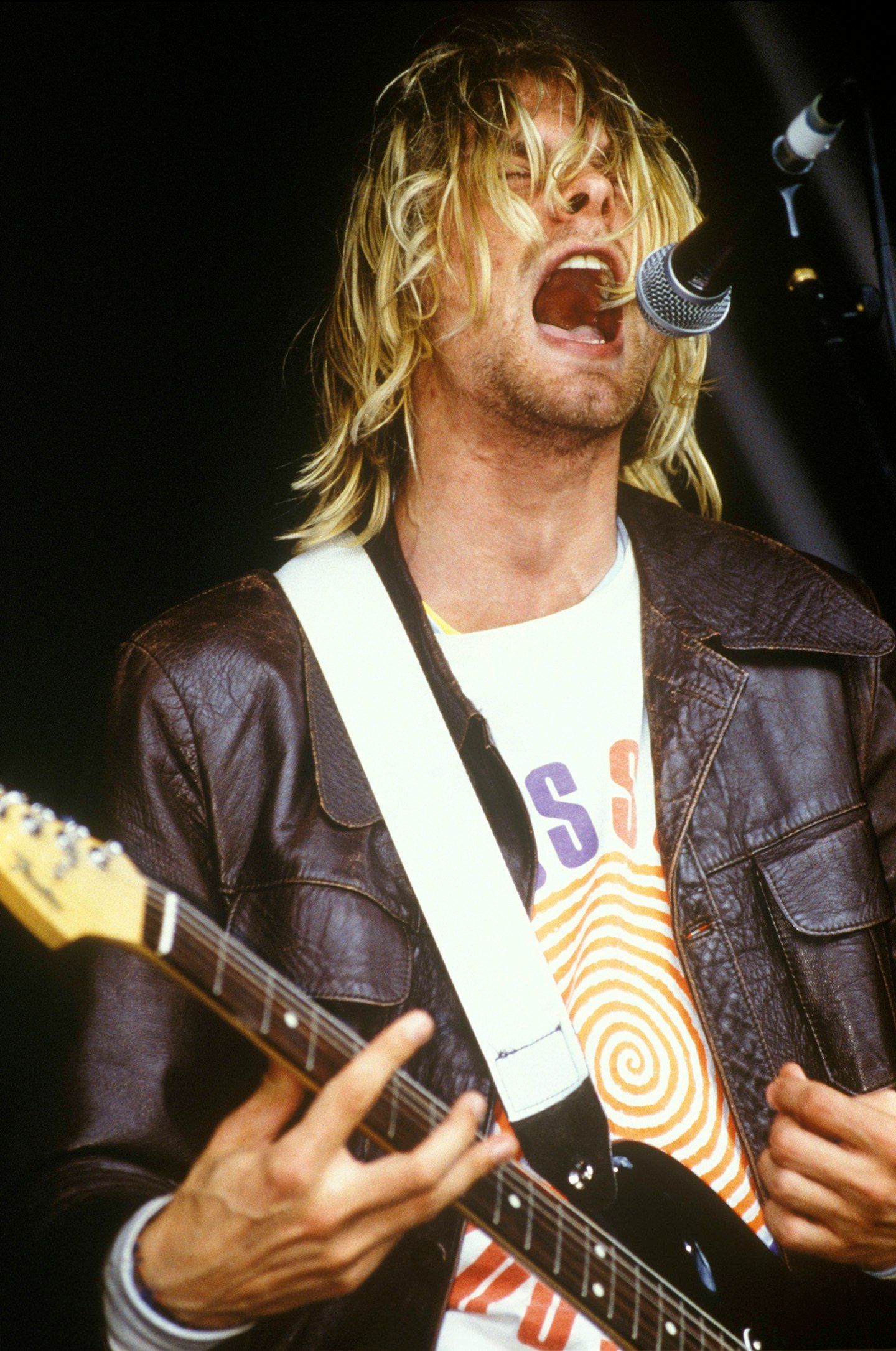
TODAY IT TAKES A particular effort to remember what Nirvana were like in 1991, because the Nirvana everyone knows now are not the band we knew then. Nirvana today are the subject of serious films and books, of academic discourse, and a major exhibit at the Experience Music Project in Seattle. Nirvana are also the stuff of endless flim-flam: of video games, comic books, dolls… and clothing. At the Reading Festival, Kurt Cobain wore a Sounds shirt which I had given him on my September 1990 visit to Seattle. I also gave shirts to Krist Novoselic and Dan Peters, who both treated the gesture as it had been intended – a little bit of a joke – and never wore the garment.
Lashed up hurriedly by the magazine’s designer, it was hardly a thing of beauty. Kurt, however, was disarmingly grateful – though perhaps simply because of his dire economic circumstances – and he wore it publicly on several occasions. I took this as a mildly subversive gesture of solidarity towards a magazine which had championed his band early on. Its last issue in April 1991 featured a live review of Nirvana from the Vancouver Commodore Ballroom, with a picture of Cobain in his shirt. No one else had ever considered Sounds cool. Yet now the shirt, like everything else Cobain ever endorsed, has its own cachet of desirability. A replica version was produced in 2009 by clothing company Worn Free, in both original white and liberty-taking powder blue with short sleeves.
This encapsulates the Nirvana experience in all its head-shaking madness. Of course, there are more significant matters with regard to this band, most obviously issues of life and death. Yet with Nevermind, both aesthetically and commercially, Nirvana altered the sound of rock music by offering a mass audience something not necessarily radical but authentically different. The conservative mainstream was now exposed to an entire substrata of US culture, one with roots in leftist politics and feminism, one that rejected orthodox power structures and was deeply suspicious towards conventional notions of success.
At the most basic level, bands as diverse as Bikini Kill and The Jesus Lizard could now reach way beyond their hitherto natural constituency, people connected via the underground network of fanzines, community radio stations and venues: a genuinely alternative lifestyle.
This shift might have happened eventually anyway, though whether the impact would have been so far-reaching is doubtful. Like all insurrections, it got co-opted and commodified almost as soon as the bottle was uncorked. But ultimately, the reason so many people still care about Nirvana is because this is a sound and a voice that speaks to millions who recognise something of themselves within.
Heard today, it feels bittersweet, just as it does to know that Dave Grohl and Krist Novoselic are playing together again, or to hear Kathleen Hanna recently explain to a New York audience the events behind her writing “Kurt smells like teen spirit” in marker pen on the wall of Kurt Cobain’s Olympia apartment, before singing the song which Nirvana gave to us all. Three decades later, it’s their world now. You have to hope it’s what he would have wanted.
Nirvana Tourbus, Cork To Dublin: August 21, 1991
Kurt: I asked my little four-year-old sister, “What’s the biggest problem in the whole world, Brianne?” And she said, “People need to concentrate more.” It was so awesome! She’s gonna grow up to be something really great… and it won’t be the president. I think denying the corporate ogre is a waste of time. You should use them, rape them the way they rape you.
Great, a world full of rapists…
Kurt:: At least you’re fighting. I don’t believe in closing off options to make your own world seem more important. (Long pause, then a smile) I think ‘empathy’ is a really nice word.
This article originally appeared in MOJO 208.