Last month, Bruce Springsteen released Streets Of Minneapolis, a protest song denouncing “King Trump and his private army” following the killing of Alex Pretti and Rennee Good by ICE officers in the city. “I wrote this song on Saturday, recorded it yesterday and released it to you today in response to the state terror being visited on the city of Minneapolis,” wrote Springsteen in an accompanying statement. “It’s dedicated to the people of Minneapolis, our innocent immigrant neighbors and in memory of Alex Pretti and Renee Good.” Listen to Streets Of Minneapolis below…
With the political chasm ever widening in America, no one can be surprised at which side of the divide Springsteen made his stand on. His concert at Manchester’s Co-op Arena in May last year featured a lengthy onstage broadside against Donald Trump, and his long history of political activism and recording songs that speak truth to power includes an entire album of tracks made popular by one of the masters of the protest song, Pete Seeger.
In the spirit of solidarity and resistance, MOJO has compiled a list of what we feel are some of the greatest protest songs ever performed, featuring tracks by Seeger, Springsteen and a host of other musicians who felt that music had the power to change the world for the better...
50.
Boogie Down Productions
Stop The Violence
(Available on: By All Means Necessary, Jive Records, 1988)
Hip hop orator KRS-One condemns drugs, guns and government corruption while entreating black America to educate itself.
49.
Lesley Gore
You Don’t Own Me
(Available on: Lesley Gore Sings Of Mixed-Up Hearts, Mercury, 1963)
Six decades on, Gore’s gloriously melodramatic statement of independence –“Don’t tell me what to do /And don’t tell me what to say” – still beats all of the Riot Grrl back-catalogue in its expression of female defiance.
48.
Junior Murvin
Police And Thieves
(Available on: Police and Thieves, Mango, 1977)
Produced and co-written by Lee Scratch Perry, the sweetness of Murvin’s delivery doesn’t diminish Police And Thieves’ anguish as unrest turned to violence on the streets of Jamaica.
47.
Serge Gainsbourg
Aux Armes Etcaetera
(Available on: Aux Armes Etcaetera, Philips/Universal 1979)
Noting the war-like jingoism of the French National anthem, Gainsbourg cut a new reggae version with Sly and Robbie. Cue: scandal, death threats and his first platinum-selling album.
46.
Linton Kwessi Johnson
Sonny’s Lettah (Anti-Sus Poem)
(Available on: Forces Of Victory, Island, 1979)
To tough, dub-wise reggae, this searing critique of the UK’s stop and search laws is narrated by a wrongly imprisoned youth and as stonily affecting as poet and activist LKJ ever got.
45.
Laura Lee
Wedlock Is A Padlock
(Available on: Women’s Love Rights, Hot Wax, 1971)
A call for gender liberation and female empowerment delivered within an irresistible soul stomper.
44.
Jimmy Cliff
Vietnam
(Available on: Jimmy Cliff, Trojan, 1969)
Reggae legend Cliff narrates a tale of a mother receiving news of her son’s death in combat, the song’s lyrical horror contrasting against the upbeat lilt of the music.
43.
Janis Ian
Society’s Child (Baby I’ve Been Thinking)
(Available on: Janis Ian, Verve/Forecast, 1967)
Then 15-year-old singer Ian delivers a plea for tolerance for an interracial romance on a track she wrote when just 13. Her performance of the song on Johnny Carson’s Tonight Show was met with a torrent of racist abuse.
42.
Bill Withers
I Can’t Write Left-Handed
(Available on: Live At Carnegie Hall, Sussex, 1973)
A subtle blend of sadness, bitterness and righteous anger permeates this tale of a Vietnam vet amputee coming to terms with life back in the States.
41.
Buffy Sainte-Marie
Universal Soldier
(Available on: It’s My Way!, Vanguard, 1964)
Donovan may have made it a hit, but Universal Soldier’s soul belonged to its Native American author. A subtle anti-war message that became a cornerstone of the anti-Vietnam movement.
40.
John Prine
Sam Stone
(Available on: John Prine, Atlantic 1971)
Long before Bruce Springsteen’s Born In The USA, singer songwriter John Prine chronicled the raw deal offered to returning Vietnam vets as a former soldier faces addiction and ultimately death.
39.
Fela Kuti
Zombie
(Available on: Zombie, Coconut, 1976)
It might be over five minutes before you hear Fela Kuti speak on Zombie, but his message is clear. Sick of martial law in Nigeria, he lays into the mindless grunts who do the government’s bidding without a second thought over turbocharged afrobeat rhythms. Shortly after its release, 1,000 soldiers stormed Kuti’s compound, attacking his family and band.
38.
Elvis Costello
Oliver’s Army
(Available on: Armed Forces, Columbia, 1979)
“If you’re out of luck or out of work, we can send you to Johannesburg…” Written after visiting Belfast in 1978, Costello penned this vicious attack on the dole-or-army trap of working-class British teens over a perversely catchy Dancing Queen piano hook.
37.
Johnny Cash
San Quentin
(Available on: At San Quentin, Columbia, 1969)
In the summer of ’69, Johnny Cash delivered this spit-fired screed against the US prison system in front of a – literally – captive audience at the song’s namesake. “San Quentin, may you rot and burn in hell…”
36.
Childish Gambino
This Is America
(Available on: non-album single, RCA, 2018)
Using his hip-hop alias Childish Gambino, Donald Glover delivered an arresting audio/visual broadside against the surreal nightmare of American violence. Following the murder of George Floyd in 2020 and the killings of US citizens by ICE officers, the song and its accompanying video’s message grows more pertinent with each passing year.
35.
Robert Wyatt
Shipbuilding
(Available on: Eps, Thirsty Ear/Domino,1999)
Elvis Costello penned the deeply human lyrics for the former Soft Machine drummer’s poignant riposte to the jingoism surrounding the Falklands war. Stick up your junta, Maggie.
34.
Creedence Clearwater Revival
Fortunate Son
(Available on: Willy And The Poor Boys, Fantasy Records,1969)
“I was thinking about David Eisenhower, the grandson of Dwight,” said John Fogerty of his attack on the privileged white kids who didn’t have to heed the call to go and fight in Vietnam. However, the sentiment could apply to some draft-dodging Commander-In-Chiefs themselves.
33.
Bruce Springsteen
Born In The USA
(Available on: Born In The USA, Columbia, 1984)
It may have been co-opted by both Ronald Regan and Donald Trump, but it doesn’t take too deep a reading to understand the clear anti-war message of Born In The USA’s bleak tale of American dreams gone horribly, horribly wrong.
32.
Tom Robinson Band
Glad To Be Gay
(Available on, Power In The Darkness, Capitol, 1978)
Weary, resentful and scathing, on Glad To Be Gay’s righteous indignation at imbecilic homophobia meets with mordant comedy – “Gay lib’s ridiculous, join in their laughter,” spits Robinson, “the buggers are legal now, what more are they after?”
31.
The Last Poets
Wake Up Niggers
(Available on: The Last Poets, Douglas, 1971)
Formed out of Harlem’s East Wind poetry workshop, The Last Poets repeatedly slammed into a world of white oppression and black statis, nowhere more so than on this group call to get out of the ghetto and rise up.
30.
Artists United Against Apartheid
Sun City
(Available on: Sun City: Artists United Against Apartheid, Razor and Tie, 1985)
E Street Band guitarist Steven Van Zandt gathered together 48 of his friends – Bruce, Bono, Bob Dylan and Keith Richards included – for this attack on apartheid, taking their name from the controversial luxury resort and casino in South Africa.
29.
Rage Against The Machine
Killing In The Name Of
(Available on: Rage Against The Machine, Epic, 1992)
Shocked by the beating of Rodney King by the LAPD, Rage Against The Machine took ferocious aim at some of the core institutions of racism and oppression in America: the police, the KKK and the military-industrial complex chief among them.
28.
Peter Gabriel
Biko
(Available on: Peter Gabriel, Charisma 1980)
In his most explicitly political song, the former Genesis leader delivered a haunting elegy to murdered anti-apartheid activist Stephen Bilko.
27.
Sly And The Family Stone
Don’t Call Me Nigger, Whitey
(Available on: Stand, Epic 1969)
The Family Stone had already broken down barriers with their multi-racial line-up and mix of gospel, soul and psychedelic rock. On 1969’s Stand, they underlined the message with a demand for respect from all sides.
26.
The Clash
White Riot
(Available on: The Clash, CBS, 1977)
Inspired by the 1976 Notting Hill riots, Joe Strummer penned this amphetamine-fired Molotov cocktail railing against schools, boredom, conformity and the general shitty deal offered those growing up in the fag end of the 70s.
25.
Curtis Mayfield
We Got To Have Peace
(Available on: Roots, Curtom, 1971)
Many protest songs use anger and scorn as their engine, but Mayfield preferred gospel’s innate drive to inspire and spiritually uplift. Most powerfully on this plea for harmony through love and understanding.
24.
Billy Bragg
There Is Power In A Union
(Available on: Talking To The Taxman About Poetry, Go! Discs,1986)
Looking to protest music’s roots in folk, The Bard Of Barking adopted elements of 19th century song The Battle Cry Of Freedom to deliver a rallying cry for workers trampled on by the Thatcher government during the miners’ strike.
23.
Country Joe And The Fish
I Feel Like I'm Fixin' To Die Rag
(Available on: I Feel Like I'm Fixin' To Die, Vanguard, 1967)
Starting life as a satirical jug band skit complete with combat sound effects and kazoo fills, Country Joe’s anti-Vietnam song found wider acceptance two years later in its 1967 electric version, its subsequent appearance in the Woodstock movie transforming it into a singalong for longhair peaceniks the world over. Altogether now…
22.
Dead Kennedys
Nazi Punks, Fuck Off
(Available on: In God We Trust, Inc. EP, Statik, 1981)
Much as it did in the UK, the far right had begun to infiltrate the American punk scene by the turn of the 80s. Jello Biafra and co. formulated this swift, 63-second riposte, at that point, the fastest rock song ever.
21.
The Beatles
Revolution
(Available on: B-side to Hey Jude, Apple, 1968)
The softer White Album version found Lennon sitting on the fence during the ’68 student revolts, but while the B-side to that year’s Hey Jude rocked far harder, here he was definitely “out” of the violence bag, opting for a message of peace and love over carrying pictures of Chairman Mao.
20.
Gil Scott Heron
The Revolution Will Not Be Televised
(Available on: Pieces Of A Man, Flying Dutchman, 1971)
Gil Scott-Heron’s searing condemnation of complacent consumerist culture was a call to arms for the Black Power era which paved the way for the righteous ire of a coming generation of hip-hop insurrectionists.
19.
Edwin Starr
War
(Available on: War And Peace, Gordy 1970)
First recorded by The Temptations, Northern Soul belter Edwin Starr’s aggressive voice did maximum justice to the message: “War? What is it good for? Absolutely nothing!”
18.
Stevie Wonder
Living For The City
(Available on: Innervisions, Tamla Motown, 1973)
Part of Wonder’s breathtaking outpouring of music in the early 70s, this slice of soul verité is a story of hope – young man arriving in big metropolis – crushed by crime, police thuggery and institutionalised racism.
17.
Grandmaster Flash & the Furious Five
The Message
(Available on: The Message, Sugar Hill Records, 1982)
Chilling and accusatory, The Message remains one of hip-hop’s most eloquently concise case studies of what drugs and poverty did to inner-city America.
16.
Band Aid
Do They Know It’s Christmas?
(Available on: single, Mercury, 1984)
Critics have since pointed to problematic lyrics and argued it perpetuated stereotypes, but Bob Geldof and Midge Ure’s rush-written chant-along raised over £8 million for Ethiopian famine relief at the time (and more since) and was the catalyst for Live Aid. As Geldof pointed out in 2024: “This little pop song has kept hundreds of thousands, if not millions, of people alive.”
15.
Phil Ochs
I Ain’t Marching Any More
(Available on: I Ain’t Marching Anymore, Elektra, 1965)
Self-styled ‘singing journalist’, Ochs was briefly folk music’s post-Dylan poster boy. I Ain’t Marching Any More listed America’s long history of aggression stretching back to the war of independence and, as the casualties piled up in Vietnam, declared that enough was enough.
14.
Crosby, Stills, Nash and Young
Ohio
(Available on: single, Atlantic, 1974)
Neil Young was comparatively apolitical before the shooting of four students at Kent State University by the National Guard in May 1970. Enraged, he penned the blistering Ohio. CSNY cut it days later, and within weeks the song was out – its fury still white-hot.
13.
NWA
Fuck The Police
(Available on: Straight Outta Compton, Priority, 1988)
Ice Cube, MC Ren and Easy E hurl invective at the LAPD’s racial profiling and brutality and in the process bring gangster rap to a wider American audience. Four years later, it became the soundtrack of the LA riots.
12.
Woody Guthrie
This Land Is Your Land
(Available on: Ultimate Collection, Prism, 2002)
Written in response to Irving Berlin’s God Bless America, This Land Is Your Land presented an alternative socialist version of the American Dream.
11.
Marvin Gaye
Inner City Blues (Make Me Wanna Holler)
(Available on: What’s Going On, Tamla, 1971)
What’s Going On signalled Marvin Gaye and Motown’s conscious awakening and none more so than on its closing track in which Gaye voices his despair at a country torn apart by war, racism and urban deprivation.
10.
Bob Marley & The Wailers
Get Up, Stand Up
(Available on: Burnin’, Island, 1973)
A repudiation of Christianity’s message to trust in Jesus to save you in the next life, Get Up, Stand Up’s demand for a better life in the here and now proved to be a potent and explosive message which became a rallying cry for the dispossessed of all persuasions.
9.
Nina Simone
Mississippi Goddam
(Available on: Nina Simone In Concert, Phillips, 1964)
In September 1963, four young girls were killed when members of the Klu Klux Klan planted dynamite in the 16th Street Baptist Church in Birmingham, Alabama, a local church used as a rallying point for the civil rights activity in the city led by Martin Luther King. Incensed, Nina Simone sat down at her piano and composed Mississippi Goddam in under an hour, “in a rush of fury, hatred, and determination”.
8.
Public Enemy
Fight The Power
(Available on: Fear Of A Black Planet, Def Jam, 1990)
Originally written for Spike Lee’s Do The Right Thing, Fight The Power took a line from the Isley Brothers’ 1975 hit to deliver hip-hop’s ultimate call to arms, Chuck D taking a pop at Elvis and John Wayne for good measure.
7.
Plastic Ono Band
Give Peace A Chance
(Available on: single, Apple, 1969)
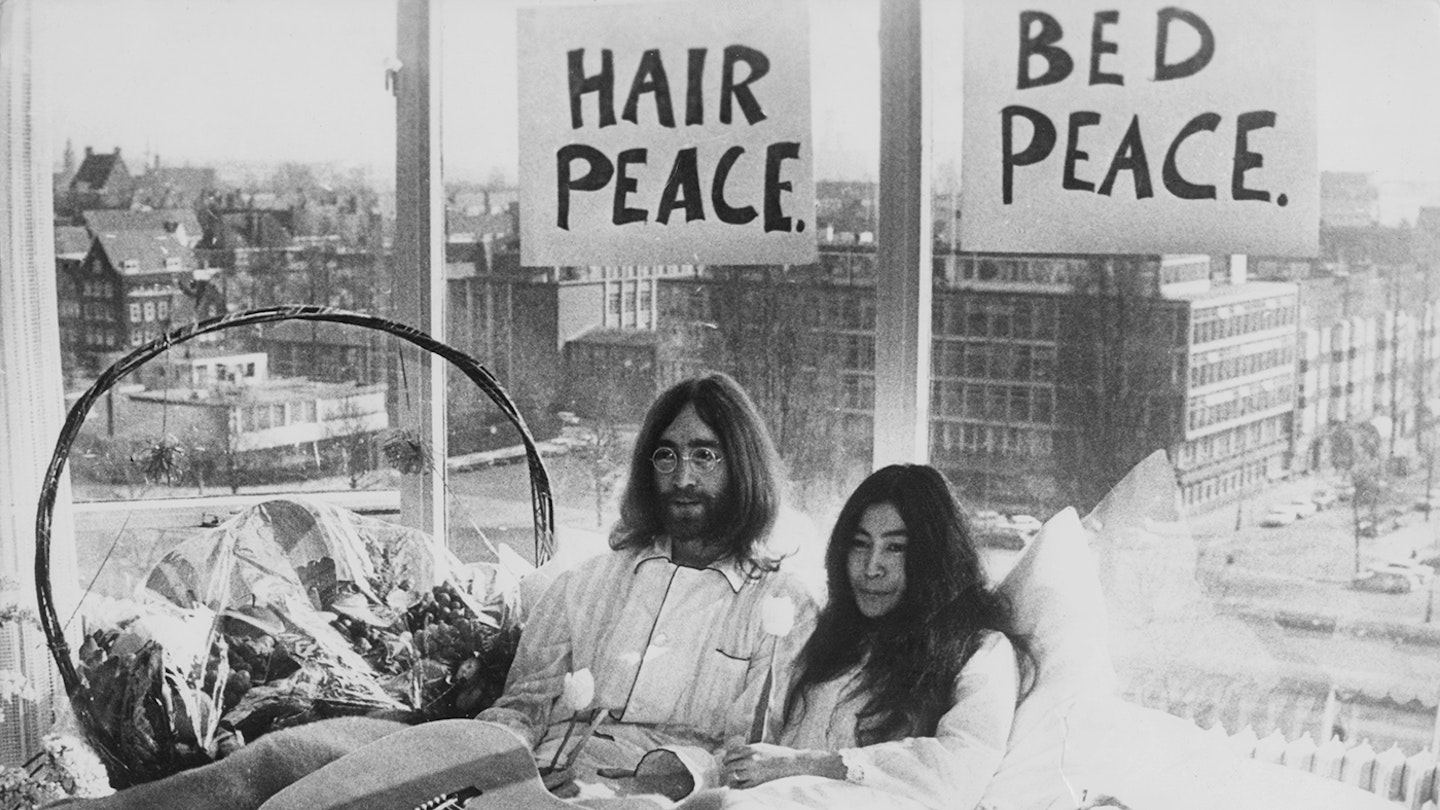
A lo-fi clap and stomp along for peace, Lennon’s first solo single, released when he was still a Beatle, was written and recorded during the newlywed John and Yoko’s bed-in protest at the Queen Elizabeth Hotel in Montreal. Among those namechecked in the lyrics were several people in the room during the recording, including Allen Ginsberg and acid guru Timothy Leary. Although not, sadly, Tommy Cooper.
6.
Special AKA
Nelson Mandela
(Available on, In The Studio, 2 Tone/Chrysalis, 1984)
Perhaps 2 Tone’s proudest achievement, Nelson Mandela demanded the release from prison of the future South African president within a joyous township jazz-inspired skank. It reached number 9 in the UK and became an international hit, raising global consciousness of the country’s oppressive apartheid regime. Mandella was finally released in February 1990 after serving 27 years in prison.
5.
Sam Cooke
A Change Is Gonna Come
(Available on: Aint That Good News, RCA Victor, 1964)
Inspired by Bob Dylan’s Blowin’ In The Wind, gospel prodigy turned soul star Sam Cooke blended gospel hope and blues anguish in a magisterial statement of aspiration for social justice. Something Cooke never lived to see as he was fatally shot less than a year after he recorded the song.
4.
Billie Holliday
Strange Fruit
(Available on: single, Commodore, 1939)
Based on a poem by High School teacher and political activist Abel Meeropol, Strange Fruit painted a graphic and horrifying image of lynched black bodies hanging from the trees of the American South. Billie Holliday’s record label Columbia refused to record it, and producer and future Atlantic Records boss hailed her reading, cut for independent Commodore, as “a declaration of war – the beginning of the civil rights movement.”
3.
James Brown
Say It Loud – I’m Black And I’m Proud
(Available on Say It Loud – I’m Black And I’m Proud, King Records, 1969)
By 1968, James Brown had become both a powerful entrepreneurial figure in the music industry and a spokesman for black America. On August 7, he rounded up some kids off the LA streets, took them into the studio and had them chant “I’m back and I’m proud!” over a ferocious funk track. “About 50 million people waiting to hear this one,” he muttered. The most direct, effective message of his many and diverse slogans, I’m Black And I’m Proud gave point and empowerment to the black pride movement while sitting just as well with the clenched fist of Black Power militants.
2.
Pete Seeger
We Shall Overcome
(Available on: Pete Seeger At Carnegie Hall, Columbia, 1963)
Believed to be adapted from an old spiritual, Pete Seeger first heard We Shall Overcome from folklorist and activist Zilphia Horton, who’d seen striking tobacco workers sing it in South Carolina. He added a verse himself, but it was when television cameras captured marchers singing the song, arms linked, during the Montgomery bus boycott in 1955 that it became synonymous with the Civil Rights movement. From picket lines to peace protests, its simple chorus can still be heard wherever the downtrodden make a stand.
1.
Bob Dylan
Masters Of War
(Available on: The Freewheelin' Bob Dylan, CBS, 1963)
Unlike, say, Where Have All The Flowers Gone by his then mentor Pete Seeger, Masters Of War was no peacenik’s pacifist lament. By the time Dylan’s seething rage reaches its apex in the final verse, the young folkie was wishing no less than death upon the suits profiteering off America’s new military-industrial complex, promising to stand over their graves ‘til he’s sure that they’re dead. Six decades on, Masters Of War’s mad-as-hell venom, and the power of its message, remain as strong as ever.